
The American trucking industry is the lifeblood of the U.S. economy, moving over 70% of the nation’s freight. As of February 2026, the industry stands at a fascinating crossroads. According to recent market data, there are approximately 659,028 active trucking businesses in the U.S., marking a 4.2% increase from the previous year. This growth brings increased competition, but also new opportunities. However, 2026 is also a year of significant regulatory changes. Recent rulings by the Federal Motor Carrier Safety Administration (FMCSA) are tightening licensing requirements. At the same time, market dynamics show a “supply-driven tightness,” meaning capacity is shrinking even if demand hasn’t fully recovered.
If you are looking to join this industry—whether as a driver, owner-operator, or dispatcher—you are entering a complex world with its own language. Understanding the lingo isn’t just about fitting in; it’s about compliance, safety, and profitability.
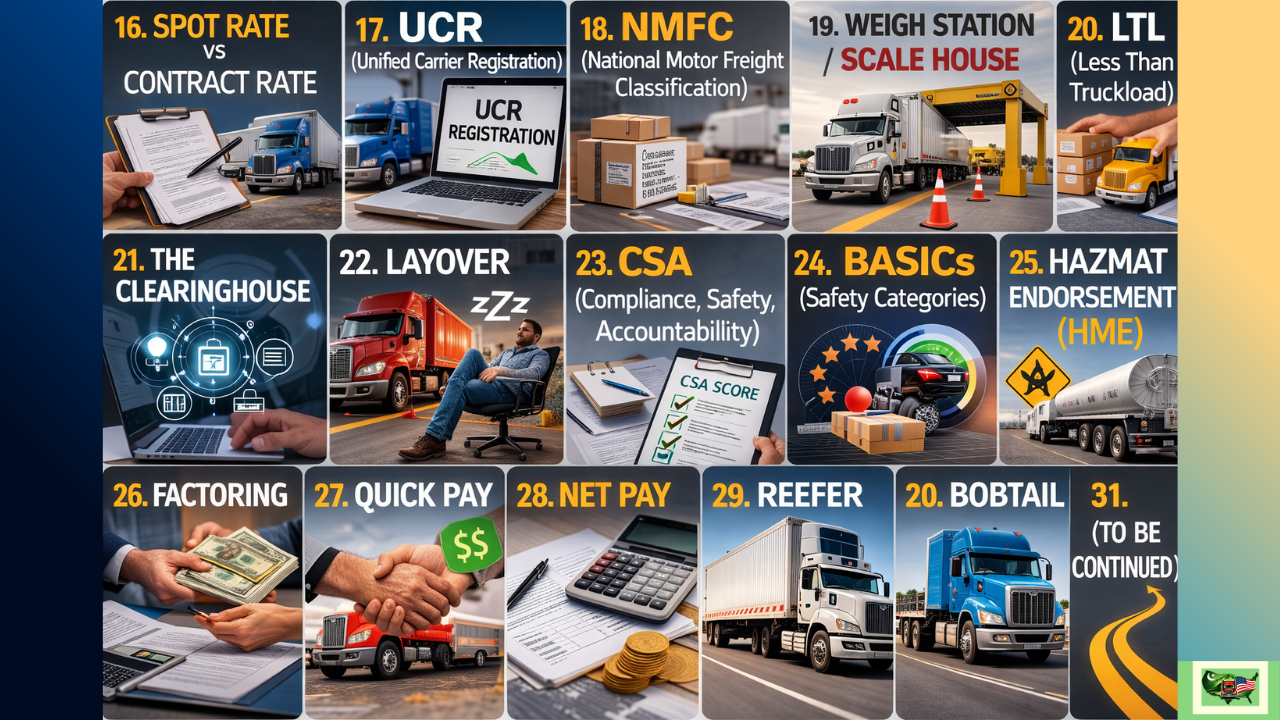
Here are some more 15 essential trucking terms you need to know, defined in simple language with examples to help you hit the ground running.
16. Spot Rate vs. Contract Rate
Contract Rate
A pre-negotiated price for shipping freight on a specific lane (e.g., Los Angeles to Dallas) over a long period.
Spot Rate
The current market price for shipping a load “right now”.
In early 2026, spot rates actually moved “above” contract rates in some areas for the first time since 2022. This is a sign of a tightening market, where capacity is scarce.
Example
A carrier might have a contract to move loads for $2.00 per mile, but if a broker needs a truck urgently today, they might offer a spot rate of $2.50 per mile to get it covered.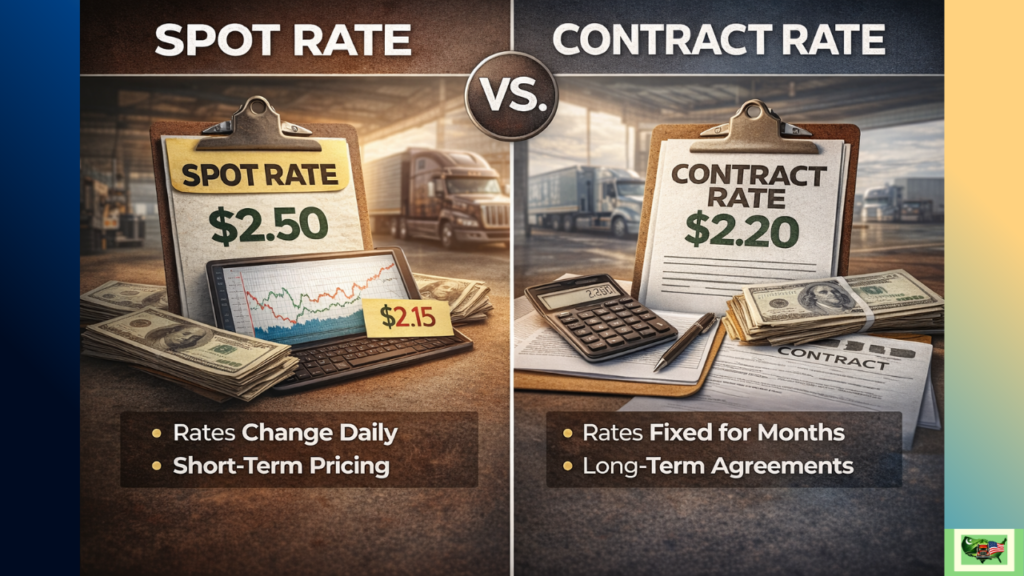
17. UCR (Unified Carrier Registration)
An annual registration and fee program that motor carriers must pay to operate in interstate commerce. The money goes to the states to support the enforcement of trucking regulations.
For 2026, the fee for a very small carrier (0-2 trucks) is approximately $49. If you have 3-5 trucks, it rises to about $146. If you fail to pay this, you risk being placed out of service during a roadside inspection.
Example
Think of UCR as a “business license” to cross state lines. Even if you only drive in one state, if you are hauling goods that came from another state (interstate commerce), you likely need to register and pay UCR annually.
18. NMFC (National Motor Freight Classification)
A standard that compares commodities moving in interstate, intrastate, and foreign commerce based on transportability. It essentially groups freight into classes (1 to 500) based on density, stowability, handling, and liability.
This determines the price of shipping for Less-than-Truckload (LTL) carriers. If you misclassify freight, you might be charged more later or face penalties.
Example
A box of feathers is light but takes up a lot of space (low density), so it has a high NMFC class (e.g., 400) and costs more per pound than a heavy, dense item like steel plates, which might be class 50.
19. Weigh Station / Scale House
An enforcement checkpoint along the highway where trucks are pulled in to be weighed and inspected for compliance.
Bypassing a weigh station that is open is a serious violation. In 2026, many weigh stations use automated systems that allow safe, compliant trucks to bypass the scales electronically if they are in good standing, saving time and fuel.
Example
You see a sign saying “Trucks Enter Scales Next Right.” Your PrePass transponder beeps green, meaning your credentials and weight are likely good, and the system clears you to bypass. If your transponder beeps red, or you don’t have one, you must pull in.
20. LTL (Less Than Truckload)
Shipments that do not require a full 48-53-foot trailer. An LTL carrier combines multiple smaller shipments from different customers into one trailer to maximize efficiency.
As an owner-operator, you might avoid LTL because it involves multiple stops and more handling, but LTL carriers (like FedEx Freight or Old Dominion) are the backbone of e-commerce and small business logistics.
Example
A furniture store orders 10 chairs from a manufacturer. That’s not enough to fill an entire truck, so the manufacturer sends them via an LTL carrier. The carrier puts that shipment on a trailer with 15 other small shipments, all heading in the same general direction.
21. The Clearinghouse
A secure FMCSA database that contains records of violations of drug and alcohol testing program regulations by commercial driver’s license (CDL) holders.
This is strictly enforced. Before you hire a driver, you must query the Clearinghouse. If a driver has a positive test or a refusal to test, it is in this database, and they are prohibited from driving until they complete the return-to-duty process.
Example
A driver applies to work for you. You must conduct a full query in the Clearinghouse, which requires the driver’s consent. If the query comes back with a “hit,” you cannot hire them until they are fully cleared by a Substance Abuse Professional (SAP).
22. Layover
A fee paid to a driver when they are forced to wait an extended period (usually overnight or more than 24 hours) to pick up or deliver a load, through no fault of their own.
Unlike detention (which covers hours), layover covers days. If a shipper’s warehouse is closed due to a holiday or breakdown and you are stuck for the weekend, you should charge a layover fee.
Example
You deliver a load on Friday morning, but your next pickup isn’t until Monday morning, and there are no other loads in the area. If the broker booked you for that Monday pickup knowing you’d have to wait, they should pay a layover fee for Saturday and Sunday.
23. CSA (Compliance, Safety, Accountability)
The FMCSA’s program to measure the safety performance of trucking companies and drivers. It scores carriers in different categories called Behavior Analysis and Safety Improvement Categories (BASICs).
This score is public. Brokers and shippers check it before hiring you. If your CSA score is bad, they will refuse to give you loads because they don’t want the liability risk.
Example
A broker is looking at two carriers for a high-value load. Carrier A has a clean CSA score. Carrier B has a poor score for “Unsafe Driving.” The broker will always pick Carrier A, even if B is cheaper.
24. BASICs (Behavior Analysis and Safety Improvement Categories)
The specific categories the FMCSA uses to calculate your CSA score. There are seven, including Unsafe Driving, Hours of Service (HOS) Compliance, Driver Fitness, Controlled Substances, Vehicle Maintenance, Hazardous Materials Compliance, and Crash Indicator.
You need to know which category is hurting you. If you get a ticket for speeding, it goes into “Unsafe Driving.” If you get a ticket for a logbook violation, it goes into “Hours of Service.” Too many violations in one category puts you in the “red zone” (high-risk).
Example
If you have three flat tire violations in six months, they all pile up in your “Vehicle Maintenance” BASIC. This flags you as a carrier who doesn’t maintain their equipment.
25. Hazmat Endorsement (HME)
A special endorsement on a CDL that allows a driver to transport hazardous materials (Hazmat) that require placards.
Getting this endorsement is rigorous. It requires a TSA threat assessment, background check, and fingerprinting. In January 2026, the FMCSA issued a final rule allowing states to waive this for drivers hauling very small amounts of jet fuel for agricultural aircraft, but for commercial hauling, the full endorsement remains mandatory.
Example
Hauling gasoline to a gas station requires a Hazmat endorsement. Hauling a single barrel of industrial cleaner that requires a “flammable” placard also requires it. Without it, you cannot touch that load.
26. Factoring
A financial service where a company (a factor) buys your unpaid freight bills (invoices) at a discount and gives you cash immediately, instead of you waiting 30, 60, or 90 days for the broker to pay.
Cash flow is king, especially for new carriers. With fuel prices volatile and maintenance costs high, waiting months for a $5,000 check can bankrupt a small carrier. Factoring gives you money in 24-48 hours.
Example
You complete a load worth $2,000. Normally, the broker pays in 30 days. If you factor the invoice, the factoring company gives you $1,940 (charging a 3% fee) today. They then collect the full $2,000 from the broker in 30 days.
27. Quick Pay
An agreement where a broker will pay a carrier faster than their standard payment terms (e.g., in 7 days instead of 30 days), usually in exchange for a small fee or discount.
If you don’t want to use a factoring company, you can often negotiate Quick Pay with a broker. It helps your cash flow, but it costs you a little bit of the load’s revenue.
Example
The standard contract says “Net 30” (paid in 30 days). You ask the broker, “Can you do Quick Pay?” They agree to pay you in 7 days if you deduct $50 from the invoice.
28. Net Pay
The amount of money an owner-operator actually takes home after all deductions from the trucking company (if leased on) or after all business expenses are paid.
New drivers often get excited about a “percentage” of the load (e.g., 70%). But Net Pay is what matters. After deductions for insurance, fuel, truck payments, and maintenance, the Net Pay is your actual profit.
Example
You haul a load for $5,000. Your company pays you 70% = $3,500. But then they deduct $800 for the truck payment, $400 for your health insurance, and $200 for fuel you put on the company card. Your Net Pay deposited in your bank is $2,100.
29. Reefer
Short for “Refrigerated Trailer.” These are temperature-controlled trailers used to haul perishable goods.
The reefer market is currently experiencing significant volatility. In early 2026, rejection rates for reefer loads spiked due to cold weather and “protect-from-freeze” demands, making it a high-demand, but high-stress sector.
Example
A truck carrying frozen French fries from Idaho to a distribution center is almost certainly using a reefer unit to keep the cargo at the correct temperature.
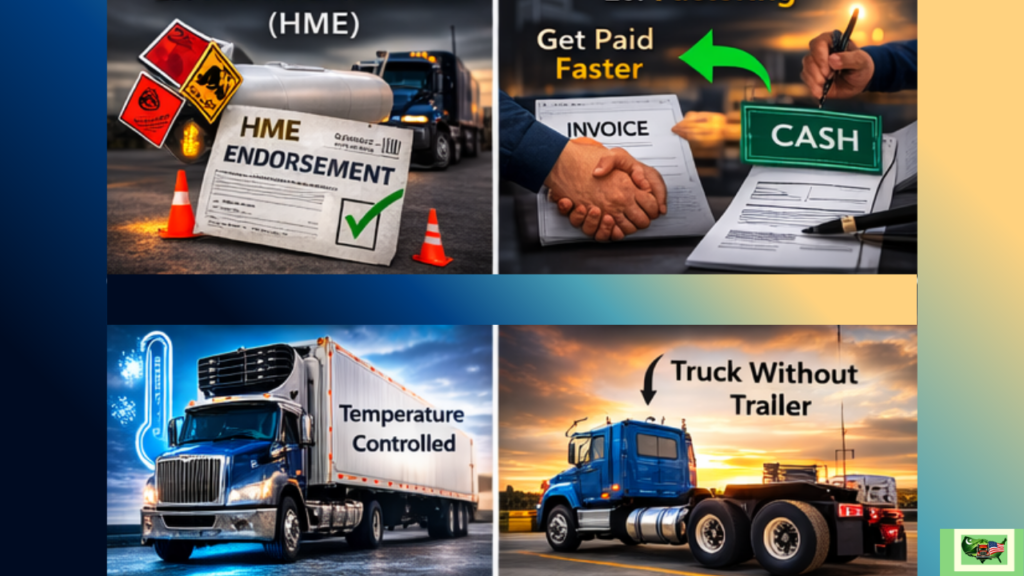
30. Bobtail
Driving a tractor (the front part of the truck) without a trailer attached.
It is essential to note that the same equipment may have different names depending on its use or region, such as Tractor, Day Cab, Power Only Unit, Running Bobtail, Big Rig, and Semi.
Bobtailing is dangerous because the drive axles carry very little weight, reducing traction. Many insurance claims happen when bobtailing in bad weather.
Example
After dropping your trailer at a customer’s dock, you drive the cab to a nearby truck stop to park for the night. You are now bobtailing.
Ph365casinoph? Solid yan! I’ve been playing there and so far, hindi pa naman ako nabibigo. Play at ph365casinoph and test your luck!
Mpo88asialogin, solid! Steady performance and a good selection of games make it my go-to choice. Visit this site! mpo88asialogin
Mga kababayan! If you’re looking for a fun place to play online, check out vph777. Legit and entertaining, highly recommended! Sulit! vph777
This is exactly what I was looking for. The promos are generous and the gameplay is genuinely exciting. My new favorite is 77pinas08
The login process is seamless and the site loads incredibly fast. Great job to the jilimklogin team.
36jili, alright alright alright! Might just jump in for one last game. i heard its quite good for bonuses, let’s hope! Jump in too with 36jili
Just having a blast on this site! The community is great and the winning streaks are feeling real today. So much fun at br777betfun
If you are looking for a variety of slots, jiliibet is where it’s at. I love how they keep updating the game library. It keeps things fresh and exciting every time I log in.
The registration process was a breeze and I was playing in under two minutes. Really impressed with the game variety here. Give jili65loginregister a go, it is totally worth it.
I’ve been looking for a reliable way to access my account and this site is definitely the smoothest. Super fast loading and no glitches. Highly recommend zb777login to everyone.
[3949]i1juta88 Login Link | Trusted Online Slot Malaysia,i1juta88 offers a secure login link for live baccarat online malaysia. Download APK for easy access and enjoy casino deposit via touch n go. Join now! visit: i1juta88
The app is incredibly lightweight and doesn’t lag even on my old phone. It makes the whole experience so much better. Check out 881betapp if you want something stable.
[9580]777vault লগইন এবং অ্যাপ ডাউনলোড – বিকাশ অনলাইন ক্যাসিনো,777vault login করুন এবং অ্যাপ download করে বিকাশ দিয়ে অনলাইন ক্যাসিনো উপভোগ করুন। এখানে পাবেন সেরা স্লট গেম ট্রিকস এবং রুলেট খেলার নিয়ম। আজই যোগ দিন। visit: 777vault
I’ve tried a few platforms recently but this one really stands out for its smooth interface. Definitely my new favorite spot to hang out and play. Check out vn1888vcom
Finally found a place where the bonuses actually make sense. Had a great run last night and the interface is very user-friendly. Check out g7777casino if you want some real action.
I’ve been playing here for a few weeks now and the payouts are surprisingly fast. Definitely one of the smoother experiences I’ve had lately. Check out may888bet for a great time.
I travel between Santiago and the coast pretty often so I need a platform that works seamlessly on any device. The bingo rooms are lively and the community chat keeps the atmosphere warm even during offpeak hours. Perfect escape from a busy workweek. bingojuegoonline
The daily rewards keep me coming back every single day. It is a great way to boost your balance while having fun. Visit logam88login for more.
Best gaming experience I have had in a while. The graphics are crisp and the gameplay is very intuitive. Give pkoppa888 a try
The app version is a game changer. I can play wherever I go without any lag. Great job on yesspinapk
Love how convenient the app version is. I can play whenever I have a break at work without any hassle. nustargamephapp is a game changer.
Just hit a decent win here and the withdrawal was processed way faster than I expected. It is hard to find honest sites these days but inyouo777 delivers.
The mobile app is a game changer. I can play anywhere without any glitches. 998jiliapp is definitely my go-to now.
The app installation was a breeze. No glitches or lag, just pure gaming. It is way better than playing on a mobile browser. Download it via ck9999download.
Fast transactions and a very secure feeling. It is hard to find sites this trustworthy these days. pkbitpkr is a total gem.
Using the app makes everything so much more convenient. I can play anywhere and anytime via 91jililoginapp
The app version is so convenient. I can play anywhere and anytime without any hiccups. Download 22jiliapps for the best mobile gaming.
Nacionalbet, getting into this site lately! Really enjoying the variety of betting markets. Plus, the customer support is pretty responsive. Check it out: nacionalbet
Best value for money I’ve seen in a while. The promotions are actually useful and not just bait. I’m staying with zi888 for the long run.
Really impressed with the security and the way they handle transactions. Everything feels safe and professional at kratonbetkr.